
How to Calculate Sea Freight Costs for FCL and LCL Shipments
In international trade, sea freight from China remains the most common and cost-effective transportation method for exporting goods. However, many shippers lack a clear understanding of the cost structures for full container load (FCL) and less than container load (LCL) shipments, leading to discrepancies when comparing prices, booking shipments, or calculating costs.
In reality, the billing logic for FCL and LCL is completely different. Only by understanding where each fee originates can you truly determine whether a particular shipment is expensive or not.

Before calculating costs, it’s essential to understand the fundamental differences between these two sea freight modes.
FCL (Full Container Load)
A single container is used for the goods of only one shipper. This is suitable for customers with large volumes of goods and stable shipping schedules.
LCL (Less than Container Load)
Goods from multiple shippers are consolidated into a single container. This is suitable for customers with smaller volumes of goods and flexible shipping schedules.
When shipping goods from China, these two modes differ significantly in terms of cost structure, risk factors, and operational complexity.
The differences between FCL and LCL
| FCL (Full Container Load) | LCL (Less than Container Load) | |
| Definition | One shipment occupies the entire container | Multiple shipments share one container |
| Suitable Cargo Volume | Large, near container capacity | Small, not enough for a full container |
| Cost Structure | Charged per container | Charged per CBM/KGS |
| Cost | Lower unit cost for large volume | Higher unit cost but cheaper for small loads |
| Operation Speed | Faster, fewer steps | Slower due to consolidation |
| Cargo Safety | High, exclusive container | Lower, mixed cargo risks |
| Transit Stability | More stable | Influenced by other cargo |
| Customs Clearance | Simple | Slightly more complex |
| Suitable Cargo Types | High-value, bulky, urgent | General goods, small batches |
| Flexibility | Cost-effective only when full | Very flexible, no MOQ |
| Container Sealing | Sealed by shipper or forwarder | Sealed at the CFS |
How to calculate LCL and FCL sea freight costs?
Ocean freight rates are comprised of the following factors:
- Basic ocean freight charges: FCL (Full Container Load) is charged based on the full container volume, while LCL (Less than Container Load) is charged based on volume/weight.
- Surcharges: Fuel surcharge, security surcharge, peak season surcharge, etc.
- Operational costs: Loading and unloading fees, warehousing fees, container freight station consolidation fees, etc.
- Other fees: Exchange rate adjustment fees, documentation fees, etc.
- Value-added services: Door-to-door pickup, customs clearance, goods inspection, insurance, and last-mile delivery.
FCL Container Shipping Cost Calculation
FCL main cost components:
Ocean Freight
- Origin Port Charges (THC, documentation fees, etc.)
- Destination Port Charges
- Customs Clearance and Delivery Fees (if required)
The core characteristic is: charging is based on the container, not on volume or weight. Regardless of the amount of cargo inside the container, as long as it doesn’t exceed the weight or container capacity limits, the freight cost remains fixed.
Note: The cost of shipping a full container from China to different countries and at different times varies. Generally, the cost of a full container is between US$1000 and US$4000. You can refer to the posts below for different container costs:
LCL Sea Freight Cost Calculation
LCL’s cost structure is more complex than FCL’s and is the most prone to calculation errors.
LCL’s Core Billing Logic
LCL costs are usually calculated based on the greater of the following two:
- Actual volume (CBM)
- Actual weight (converted at 1 CBM = 1000 KG)
In addition, several handling fees will be added.
Common LCL Cost Components
- Sea freight (per CBM or ton)
- Origin port consolidation fee
- Destination port deconsolidation fee
- Documentation and handling fees
- Customs clearance and delivery fees
| Charge Item | Calculation Basis |
|---|---|
| Ocean Freight | Per CBM or per ton |
| Origin CFS Fee | Per CBM |
| Destination CFS Fee | Per CBM |
| Documentation Fee | Per shipment |
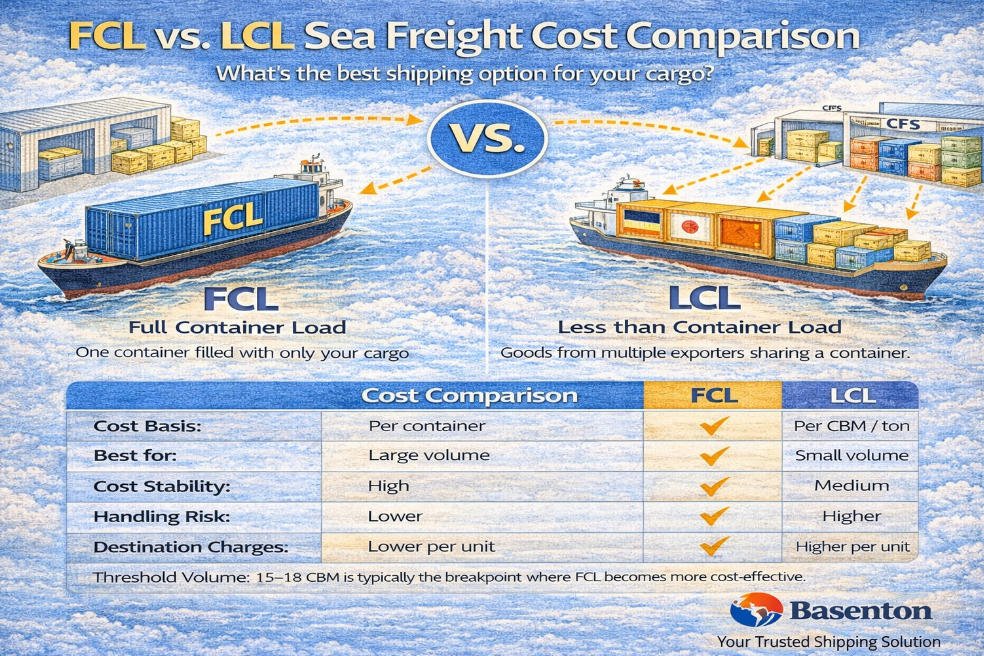
FCL vs LCL Sea Freight Cost Comparison
| Item | FCL | LCL |
|---|---|---|
| Cost Basis | Per container | Per CBM / ton |
| Best for | Large volume | Small volume |
| Cost Stability | High | Medium |
| Handling Risk | Lower | Higher |
| Destination Charges | Lower per unit | Higher per unit |
FCL and LCL Calculation Steps:
- Obtain basic freight charges: Provide cargo information and obtain a quote from the freight forwarder.
- Add the charges for the port of origin and the port of destination.
- Include surcharges.
- Add optional services (e.g., insurance, trucking services).
Total cost = Basic freight charges + Port of origin/destination charges + Surcharges + Optional services
This article was compiled by Basenton Logistics and first published on its website. Please indicate the source as Basenton when reproducing or copying this information on other websites.
How to Choose Between FCL and LCL for the Most Cost-Effective Shipping?
How to choose between FCL (Full Container Load) and LCL (Less than Container Load) for the most cost-effective shipping from China? There’s no single answer to this question, but you can use a simple logic to determine the best option:
Cargo Volume ≥ 15–18 CBM:
Usually, this volume approaches the cost of a full container, making FCL more cost-effective.
Cargo Volume < 10 CBM:
LCL is more flexible and suitable for test orders or multiple shipments.
When shipping from China to destinations such as the US, Europe, and the Middle East, this “critical point” may vary slightly depending on the shipping route and market conditions.
Hidden Costs of Sea Freight from China That Are Often Overlooked
Many shippers only focus on the “sea freight” cost when calculating shipping expenses, but the real cost drivers are often the following:
- High handling fees at the destination port
- Demurrage charges due to customs clearance delays
- Low efficiency of LCL unpacking and higher delivery costs
- Inefficient container type selection leading to wasted loading capacity
These issues can actually be anticipated and optimized before shipment.
The Value of Freight Forwarders in Calculating Sea Freight Costs
For individuals or businesses needing to ship goods from China, sea freight costs are not just a “pricing issue,” but rather a matter of overall logistics solution design.
Experienced Chinese freight forwarders typically assist clients before shipment by:
- Determining the cost breakpoint between FCL and LCL
- Evaluating the destination port cost structure
- Optimizing container type and loading plan
- Providing warnings about potential additional costs
Basenton Logistics, as an international freight forwarding company in China, through its long-term service to sea freight clients, provides clients with FCL or LCL solutions that are closer to actual costs, based on cargo volume, destination port, and delivery method, helping to avoid situations where the initial quote is cheap but the final cost is very expensive.
News
Berita Teknologi
Berita Olahraga
Sports news
sports
Motivation
football prediction
technology
Berita Technologi
Berita Terkini
Tempat Wisata
News Flash
Football
Gaming
Game News
Gamers
Jasa Artikel
Jasa Backlink
Agen234
Agen234
Agen234
Resep
Cek Ongkir Cargo
Download Film
