
What Are Amazon FBA Fees? How Are They Calculated?
For sellers using Amazon FBA (Fulfillment by Amazon), FBA fees are often a key factor affecting profits. Many sellers only focus on the product purchase price and international shipping costs when calculating costs, but underestimate the cumulative impact of various FBA fees, ultimately leading to severely squeezed profits.
Sellers shipping from China to Amazon FBA warehouses in the United States especially need a systematic understanding of the composition and calculation methods of FBA fees to make more rational decisions regarding product selection, pricing, and logistics solutions.

What are Amazon FBA fees?
Amazon FBA fees refer to the service costs incurred when sellers store their inventory in Amazon warehouses, and Amazon handles picking, packing, delivery, and customer service. These fees are not a single item but rather comprised of multiple modules.
FBA fees are typically closely related to product size, weight, sales velocity, inventory turnover rate, and seasonal factors. Even for the same product, slight variations in packaging size or weight can result in significant differences in the final cost.
For Chinese sellers, FBA fees need to be calculated in conjunction with international shipping costs, customs clearance fees, and tariffs to arrive at the true “landing cost.”
What is Amazon FBA
Main Amazon FBA Fee Structure
| Fee Type | Charged Based On | Typical Cost Range |
|---|---|---|
| Fulfillment Fee | Size & Shipping Weight | USD 3 – 12 per unit |
| Monthly Storage Fee | Cubic Feet / Month | USD 0.87 – 3.63 |
| Long-Term Storage Fee | Storage Duration | USD 6.90+ per cubic foot |
| Removal Fee | Unit Weight | USD 0.25 – 1.50 |
Fulfillment Fee
Fulfillment fees are the charges Amazon incurs for picking, packing, and last-mile delivery for each order. This is the core fee in FBA.
This fee is primarily determined by the product’s shipping weight and size tier, not its selling price. Larger but lighter products often incur higher fulfillment fees.
Sellers should carefully consider size control during the product design and packaging stages; otherwise, high fulfillment fees can easily erode profits during the FBA process.
Monthly Storage Fee
Amazon charges sellers monthly storage fees, calculated based on the warehouse volume (cubic feet) occupied by the product.
Storage fees exhibit significant seasonal variations:
- January–September is the off-season.
- October–December is the peak season (fees are significantly higher).
If a large quantity of goods is shipped from China at once, resulting in slow inventory turnover, storage fees can accumulate over time, becoming a hidden cost.
Long-Term Storage Fee
Long-term storage fees may be triggered when inventory remains in Amazon warehouses for a certain period (e.g., 180 days or 365 days).
These fees are typically much higher than regular storage fees and are a mechanism Amazon uses to “force sellers to clear inventory.”
For sellers with supply chains in China and long replenishment cycles, a more refined replenishment plan is needed to avoid one-time overstocking.
Removal & Disposal Fees
These fees apply when sellers need to remove inventory from Amazon warehouses or choose to have Amazon destroy inventory directly.
These fees are common during periods of slow-moving products, account adjustments, or inventory clearance. While the unit price may be low, the cost can be significant when operating in bulk.
What is the impact of shipping from China to Amazon FBA in the US on cost calculation?
A suitable international logistics solution directly affects the FBA cost structure.
For example:
- Inappropriate packaging dimensions will increase FBA fulfillment costs.
- Oversized outer cartons may be rejected by Amazon or subject to re-billing.
- Incorrect customs clearance information can cause warehousing delays and increase storage costs.
Amazon FBA: Packaging, Labeling, and Pallet Specification Guide
Therefore, FBA costs are not calculated “after arrival at the warehouse,” but are largely determined before shipment from China.
Cost of Shipping from China to Amazon FBA
Cost structure
Freight: calculated based on the mode of transportation and the weight/volume of the goods.
Customs clearance fees: including tariffs and other related fees.
Freight forwarding service fees: various service fees provided by the freight forwarding company.
Cost estimation
Sea freight: about US$2,000-4,000 per container
Air freight: about US$5-15/kg.
Express delivery: about US$20-30/kg.
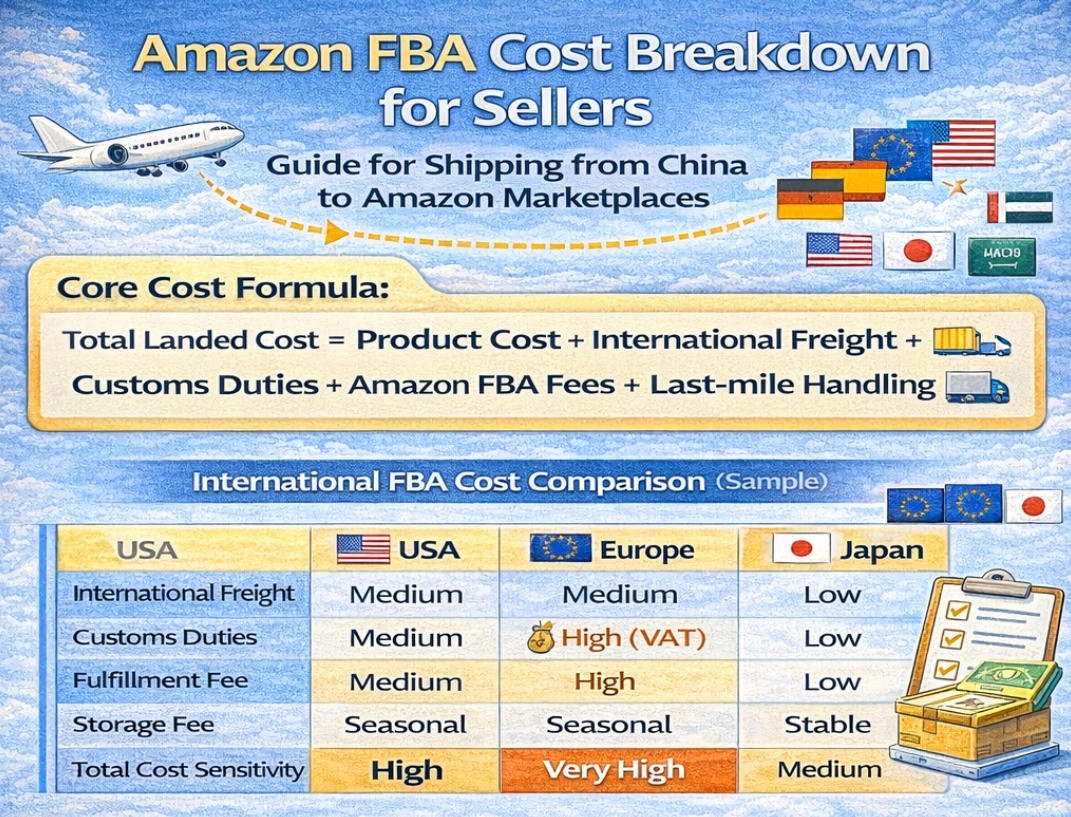
Note: Many sellers only look at FBA fees or international shipping costs, but the real determinant of profit is the total landed cost.
A Complete FBA Cost Formula:
Total Landed Cost = Product Cost + International Freight + Customs & Duties + Amazon FBA Fees + Last-mile Handling
Learn more:
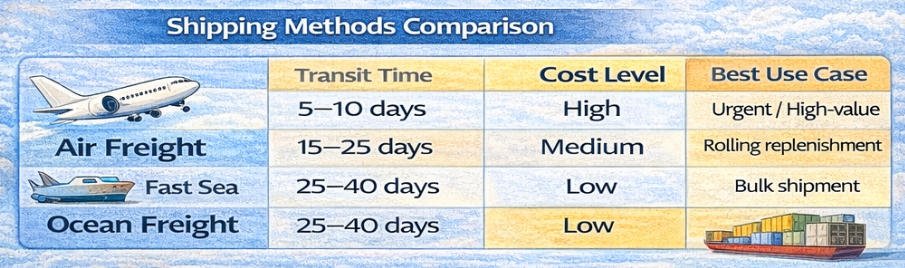
Time from China Shipping to Amazon Warehouse
| Shipping Method | Transit Time | Cost Level | Best Use Case |
|---|---|---|---|
| Air Freight | 5–10 days | High | Urgent / High-value |
| Ocean Freight | 25–40 days | Low | Bulk shipment |
Amazon FBA is not limited to the US: An overview of warehouses in other major countries
While the US is Amazon FBA’s largest market, in recent years, an increasing number of Chinese sellers have begun to expand into European, Japanese, Middle Eastern, and Canadian markets to diversify risk and acquire new growth.
FBA warehouses in different countries differ significantly in cost structures, customs requirements, and logistics routes. Using a “US mindset” to calculate costs can easily lead to misjudgments of profit.
| Cost Item | USA | Europe | Japan |
|---|---|---|---|
| International Freight | Medium | High | High |
| Customs & Duties | Medium | High (VAT) | Low |
| Fulfillment Fee | Medium | Medium | Low |
| Storage Fee | Seasonal | Seasonal | Stable |
| Total Cost Sensitivity | High | Very High | Medium |
Major Amazon FBA Markets (Non-US)
Europe (UK / Germany / France / Italy / Spain): Multi-country warehouse collaboration, involves VAT and EORI, suitable for standardized products.
Canada (CA): Similar to the US, but customs clearance and delivery costs are slightly higher.
Japan (JP): Strict requirements for packaging and labeling, high proportion of air freight.
Middle East (UAE / Saudi Arabia): Rapid FBA growth, but high customs compliance requirements.
Additional Considerations for FBA in Different Countries
European FBA
- VAT registration is a prerequisite.
- Multi-country warehousing increases tax and transfer costs.
Japanese FBA
- Outer box size and labeling requirements are very strict.
- Oversized goods incur significantly higher fulfillment fees.
Middle Eastern FBA
- Customs clearance compliance is more important than price.
- DDP or door-to-door solutions are recommended.
Practical Advice: How to Control Total Amazon FBA Costs?
- Consider FBA size categories during product development.
- Repeatedly verify outer box data before shipping from China.
- Control replenishment quantities to avoid inventory buildup.
- Regularly review FBA expense reports and adjust prices promptly.
Amazon FBA isn’t about whether it’s “expensive” or “not expensive,” but rather whether it’s being calculated and managed effectively.
Can using DDP/door-to-door shipping reduce FBA risks and costs?
More and more Chinese sellers are choosing DDP (Delivered Duty Paid) or door-to-door shipping, entrusting customs clearance, duties, and delivery to freight forwarders.
Through experienced Chinese freight forwarding companies, you can:
- Optimize outer box dimensions and weight
- Declare HS Codes correctly to reduce customs clearance risks
- Ensure warehousing appointments are compliant, reducing the probability of Amazon rejection
DDP Shipping from China
Freight forwarding from China to Amazon FBA
The advantages of choosing a freight forwarder to consolidate FBA shipments from China to Amazon warehouses.
Chinese freight forwarding companies like Basenton, which have long served Amazon sellers, can customize more reasonable transportation and warehousing solutions based on product attributes and FBA warehouse requirements, helping sellers control overall costs from the source.
- Optimize outer box dimensions to reduce FBA fulfillment costs
- Design combined air/sea/fast shipping solutions
- Provide DDP/door-to-door services to reduce customs clearance risks
- Develop differentiated solutions for FBA warehouses in different countries
FAQ:
Q1: Are Amazon FBA fees fixed?
- No. FBA fees vary depending on size, weight, season, and warehouse policies.
Q2: Is air freight always more expensive than sea freight?
- Not necessarily. For bulky but lightweight products, air freight may actually be more manageable.
Q3: Why are actual FBA costs higher than estimated?
- Common reasons include oversized outer boxes, excessively long storage periods, and re-measurement of weight.
Q4: Is DDP always required when shipping from China?
- Not mandatory, but DDP can significantly reduce customs clearance and warehousing risks, especially for new sellers.
Q5: Are there significant differences in FBA fees between different countries?
- The fulfillment fee structure is similar, but taxes, delivery, and compliance costs vary considerably.
News
Berita Teknologi
Berita Olahraga
Sports news
sports
Motivation
football prediction
technology
Berita Technologi
Berita Terkini
Tempat Wisata
News Flash
Football
Gaming
Game News
Gamers
Jasa Artikel
Jasa Backlink
Agen234
Agen234
Agen234
Resep
Cek Ongkir Cargo
Download Film
