
Definitions of Net Weight and Gross Weight: Which One Is Used to Calculate Shipping Costs
In international logistics and import/export trade, “weight” is one of the core factors affecting transportation costs. However, in practice, many shippers and importers, especially those shipping goods from China for the first time, often confuse net weight and gross weight, leading to inaccurate freight cost estimates, repeated communication during customs clearance, and even additional costs.
Correctly understanding the difference between net weight and gross weight helps avoid unnecessary misunderstandings and cost risks during booking, quoting, and customs clearance.
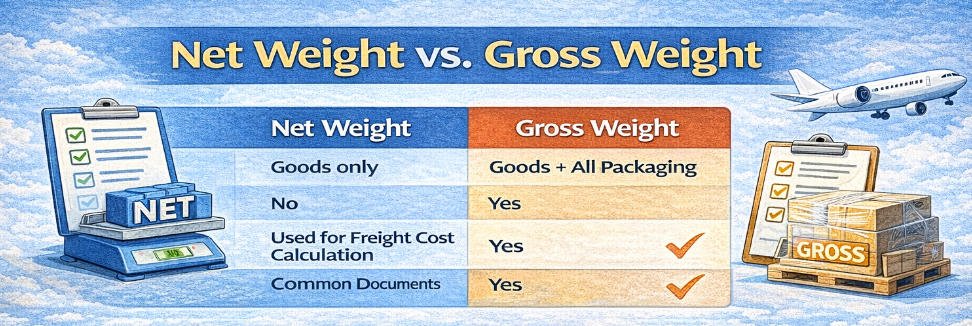
What is Net Weight?
Net weight refers to the actual weight of the goods themselves, excluding any packaging materials, pallets, crates, or cushioning materials. Simply put, it’s the weight of the product “itself.”
In international trade, net weight is primarily used for:
- Commercial invoices
- Product labels and technical specifications
- Customs declarations
- Product compliance and regulatory purposes
Net weight is typically indicated on products such as food, pharmaceuticals, and industrial goods. For example, a coffee bag labeled “Net Weight 1 lb” means the coffee itself, excluding the packaging, weighs 1 pound. For shipping companies and importers, net weight is also useful in bulk shipments to calculate the usable volume of the product being transported, excluding pallets, containers, or protective packaging.
Net weight is commonly used to calculate duties and other taxes payable. Incorrect net weight information can lead to overpayment of taxes or legal disputes, especially in cross-border trade.
Customs authorities use net weight to more accurately determine the quantity and nature of goods and whether they comply with import regulations.
What is Gross Weight?
Gross weight refers to the total weight of the goods including all packaging materials, such as cardboard boxes, wooden pallets, wooden crates, strapping, and moisture-proof materials.
From a logistics perspective, gross weight is the actual weight that is handled, loaded, and transported during the shipping process. Therefore, carriers and freight forwarders are more concerned with gross weight than net weight.
In practice, gross weight is often significantly greater than net weight, especially for machinery, fragile goods, or goods requiring reinforced packaging.
For example, if a shipment of solar panels has a net weight of 500 kg, including 100 kg of wooden pallets and protective foam, its gross weight would be 600 kg. Carriers and freight forwarders will use this total weight to calculate transportation costs and allocate space.
The importance of gross weight in transportation and compliance cannot be overlooked. Overloaded trucks or containers can lead to fines, disruptions in cargo transport, and other safety hazards. Accurate gross weight is crucial for both regulatory agencies and transportation companies, as it relates to compliance and efficient cargo handling.
Is shipping cost calculated based on net weight or gross weight?
In the vast majority of international shipping scenarios, freight costs are calculated based on gross weight, not net weight.
Whether it’s sea freight, air freight, or multimodal transport, carriers use the following factors as the basis for billing:
- Gross Weight
- Volume (CBM)
- Chargeable Weight (the greater of weight and volumetric weight)
This is because transportation costs depend on the actual capacity and space occupied by the goods, not the weight of the product itself.
The Difference Between Net Weight and Gross Weight in Ocean Freight
In ocean freight, especially for Full Container Load (FCL) and Less than Container Load (LCL) shipments, gross weight is a core reference data point.
Shipping companies and port operations use gross weight to arrange container loading, stowage, and security checks. Furthermore, according to international regulations, export containers must declare their VGM (Verified Gross Weight), which is the gross weight.
Inaccurate gross weight declaration may result in:
- Refusal to load the container
- Port fines
- Delays or even container abandonment during shipping
Accurate gross weight declaration is a crucial step when exporting goods from China by sea.
How do net weight and gross weight affect air freight costs?
Air freight is more stringent in weight calculation. Airlines use chargeable weight, which is the higher of the following two values:
- Actual gross weight
- Volume weight (Length × Width × Height ÷ 6000)
Even if the net weight of the goods is not high, if the packaging volume is large, the air freight cost will still be significantly higher. Therefore, both weight and volume factors need to be considered during the packaging design stage for air freight.
Example:
- Carton dimensions: 100 cm × 80 cm × 60 cm
- Number of cartons: 1
- Actual gross weight: 60 kg
Calculate volumetric weight
- Volume weight = (Length × Width × Height) ÷ 6000
- Volume weight = (100 × 80 × 60) ÷ 6000
- Volume weight = 80 kg
Therefore, the airline will charge based on 80 kg, not 60 kg.
Note: Airlines always calculate freight charges based on gross weight or volumetric weight, not net weight. Oversized packaging significantly increases air freight costs. Therefore, both weight and volume factors need to be considered during the packaging design phase for air cargo.
This is especially important for electronic products, samples, and high-value goods exported from China by air.
Net Weight vs Gross Weight Comparison Table
| Item | Net Weight | Gross Weight |
|---|---|---|
| Definition | Weight of the goods only | Total weight including packaging |
| Includes Packaging | No | Yes |
| Used for Freight Cost Calculation | No | Yes |
| Used for Customs Declaration | Yes | Yes |
| Common Documents | Commercial Invoice, Product Label | Packing List, Bill of Lading, VGM |
| Relevance to Transport Planning | Low | High |
| Typical Use Case | Product compliance, customs reference | Freight pricing, loading, safety |
| Impact on Shipping Cost | None | Direct impact |
| Common Mistakes | Confusing with chargeable weight | Underestimating packaging weight |
Why is gross weight more important when shipping goods from China?
Goods exported from China typically use robust export packaging to withstand long-distance transport, frequent loading and unloading, and diverse logistical environments in different countries. While this packaging improves security, it also significantly increases gross weight.
In practice, many clients only provide freight forwarders with the net weight of the product, ignoring the actual weight after packaging. This ultimately leads to:
Confirming the gross weight in advance helps shippers more accurately assess transportation costs.
Common Misconceptions about Net Weight and Gross Weight
One common misconception is that “customs uses net weight, and freight costs are based on gross weight.” In reality, customs focuses on declaration compliance, while transportation focuses on carrying costs; their focuses differ.
Another misconception is neglecting the weight of pallets and crates. In international shipping, the weight of pallets and crates is often significant, especially in the transport of machinery and large cargo.
The Role of Freight Forwarders in Weight Confirmation
Professional freight forwarders typically assist clients before shipment by:
- verifying net and gross weight data
- assessing the impact of packaging on freight costs
- estimated chargeable weight in advance
- avoiding disputes over fees due to weight issues
Basenton Logistics, as a Chinese freight forwarder, assists clients in confirming weight information in advance during the booking and documentation stages when handling sea and air freight from China to destinations worldwide. This helps clients more accurately control transportation costs and reduce unnecessary adjustments and risks later on.
This article was compiled by Basenton Logistics and first published on its website. Please indicate the source as Basenton when reproducing or copying this information on other websites.
News
Berita Teknologi
Berita Olahraga
Sports news
sports
Motivation
football prediction
technology
Berita Technologi
Berita Terkini
Tempat Wisata
News Flash
Football
Gaming
Game News
Gamers
Jasa Artikel
Jasa Backlink
Agen234
Agen234
Agen234
Resep
Cek Ongkir Cargo
Download Film
