
The Role of Certificates of Origin (COO) in International Shipping
In international trade and cross-border logistics, a Certificate of Origin (COO) is not an optional document. It directly impacts tariff rates, customs clearance speed, trade compliance, and even determines whether a shipment can successfully enter the destination country’s market. For companies exporting goods from China, correctly understanding and utilizing COOs is a crucial step in reducing risks and costs.
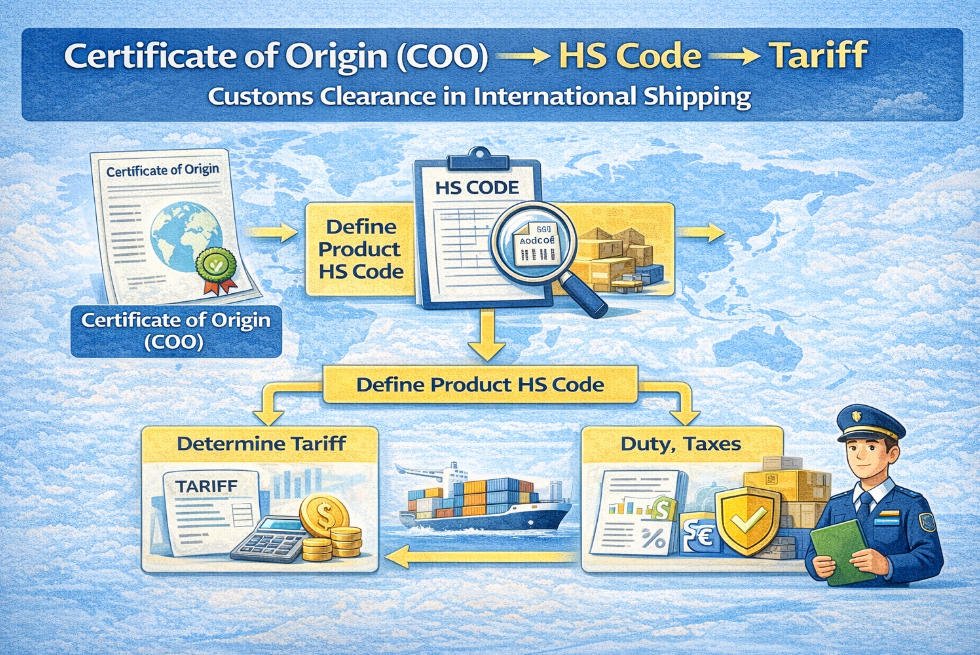
What is a Certificate of Origin (COO)?
A Certificate of Origin is a document issued by an official agency or authorized organization in the exporting country to certify the country of origin of goods, i.e., where the goods were produced, manufactured, or substantially processed. In international trade, customs authorities are not only concerned with “where the goods were shipped from,” but more importantly, “where the goods truly originated.”
COOs are typically used to confirm whether goods comply with certain trade agreements, are eligible for preferential tariffs, or are subject to trade restrictions. Even if goods are exported from China, the determination of origin may differ if the main processing stages took place in another country.
In practice, a COO is not a single type of document, but rather exists in various forms depending on the trade relationship, agreements, and requirements of the destination country.
The Core Role of Certificates of Origin (COO) in International Shipping
Determining Tariff Rates and Preferential Policies
Many countries and regions offer preferential tariffs or even zero tariffs for goods from specific countries of origin, such as those under Free Trade Agreements (FTAs). Whether these policies can be enjoyed depends primarily on the Certificate of Origin.
Without a valid COO, customs will usually levy taxes at the Most Favored Nation (MFN) rate or the general tariff rate, directly increasing import costs.
Affecting Customs Clearance Speed and Compliance Review
In markets such as the United States, the European Union, the Middle East, and Africa, customs authorities are increasingly scrutinizing origin information. Incomplete or inconsistent COO information often triggers manual inspections or requests for additional documentation, causing customs clearance delays.
Especially in the context of anti-dumping, countervailing duties, or trade disputes, origin issues are more likely to become a focus of customs scrutiny.
Meeting Import Country Regulations and Market Access Requirements
Some countries or industries have specific restrictions on the origin of products, such as agricultural products, chemicals, steel products, and textiles. The COO is one of the important documents proving that goods comply with import regulations.
Without a valid certificate of origin, goods may be subject to re-declaration, requests for additional documentation, or even refusal of entry.
Common Types of Certificates of Origin
In the practical operation of exporting from China, common types of Certificates of Origin (COO) include:
General Certificate of Origin (General COO)
Used for general trade that does not involve tariff preferences, and has the widest scope of application.
Preferential Certificate of Origin (Preferential COO)
Used under free trade agreements, such as FORM E, FORM A, FORM R, etc., allowing for tariff reductions.
Chamber of Commerce Certificate of Origin (Chamber of Commerce COO)
Usually issued by the China Council for the Promotion of International Trade (CCPIT) or local chambers of commerce, and recognized by most countries.
The acceptance of different types of COOs varies across different countries and commodities, so prior confirmation is crucial.
What is the difference between a general COO and a preferential COO?
A general COO only confirms the country of origin and does not provide tariff benefits. It is widely used for standard customs clearance and trade documentation.
A preferential COO is issued under a specific free trade agreement (FTA) and allows the importer to claim reduced or zero import duties. Common examples include FORM E and other FTA-based certificates.
Choosing the wrong type of COO may result in denied tariff benefits or customs rejection.
The Relationship Between COO and Sea/Air Freight
Whether by sea or air, the Certificate of Origin (COO) is a core component of the customs clearance document system and is not exempted regardless of the mode of transport.
Sea Freight:
Due to high cargo value and long transportation cycles, errors in the COO are often only discovered at the destination port, resulting in higher modification costs and increased delay risks.
Air Freight:
The customs clearance process is faster, and customs authorities have stricter requirements for document completeness. Any issues with the COO information can easily lead to cargo being held up at the airport.
Therefore, confirming the COO type and issuance method before booking is a crucial step in professional freight forwarding operations.
How does the HS Code relate to the Certificate of Origin?
The HS Code and COO work together during customs clearance. The HS Code classifies the product, while the COO determines its origin for tariff and policy purposes.
If the HS Code does not match the product description stated on the COO, customs authorities may question the accuracy of the declaration, leading to inspections or penalties.
Accurate HS Code classification is essential to ensure the COO is accepted and correctly applied during customs clearance.
Common Risks and Errors in Certificates of Origin
In practice, the most common problems encountered by businesses include:
- Inconsistencies between the origin description and the commercial invoice/packing list
- Insufficient processing steps to meet the rules of origin
- Incorrect certificate type selected, resulting in the inability to enjoy tariff preferences
- Issuing authority not recognized by the customs of the destination country
These problems are not necessarily “violations,” but they can lead to customs clearance delays and even fines.
The following is a summary of the most common origin errors that lead to customs detention and additional costs. Use this checklist to identify potential problems before shipment.
| COO mistake that triggers customs holds | Likely result | Quick fix |
|---|---|---|
| Description mismatch between COO, commercial invoice, and packing list | Hold or correction | Use the same wording across all documents |
| Wrong COO type, preferential vs non-preferential | Preference denied | Confirm the correct type before applying |
| Weak origin support when imported materials are used | Proof requested | Prepare a basic origin evidence file |
| Issuer or format not accepted, stamp or signature missing | COO rejected | Check destination requirements before shipping |
| Original COO required but eCOO submitted | Release delayed | Confirm original vs eCOO requirement |
| HS classification logic inconsistent | Preference denied or review | Align HS logic before issuing the COO |
| Shipper or consignee name and address mismatch | Discrepancy, bank or customs hold | Standardize party details across documents |
The Role of Freight Forwarding Companies in COO Management
Professional Chinese freight forwarding companies are not only responsible for transportation but should also assist clients in mitigating origin risks during the documentation phase. This includes:
- Determining whether a Certificate of Origin (COO) is required
- Assisting in selecting the appropriate type of Certificate of Origin
- Verifying HS codes and rules of origin in advance
- Ensuring consistency between the COO and customs clearance documents
In complex markets (such as the US, EU, and the Middle East), experienced freight forwarders can significantly reduce compliance risks.
Why is choosing an experienced freight forwarding company more important when exporting from China?
For goods exported from China to countries worldwide, the Certificate of Origin is just one part of the customs clearance system, but it is the most easily overlooked and most prone to problems.
Chinese freight forwarding companies like Basenton Logistics, through their long-term experience handling routes to the US, Europe, and the Middle East, have developed relatively mature COO document review and customs clearance coordination processes. By intervening in the document preparation stage in advance, they can help clients reduce unnecessary tariff expenses, lower the risk of customs inspections and delays, and make the international transportation process more controllable.
This article was compiled by Basenton Logistics and first published on its website. Please indicate the source as Basenton when reproducing or copying this information on other websites.
FAQ:
Can an incorrect COO cause customs delays or cargo seizure?
Yes. An incorrect or inconsistent COO is a common reason for customs delays and increased inspection rates.
Typical issues include:
- Origin mismatch with manufacturing process
- Incorrect product description
- Invalid issuing authority
- Conflict between COO, commercial invoice, and packing list
In severe cases, shipments may be detained until corrected documents are submitted.
Who issues Certificates of Origin in China?
In China, COOs are typically issued by:
- China Council for the Promotion of International Trade (CCPIT)
- Authorized local chambers of commerce
- Approved government agencies for preferential certificates
The issuing body must be recognized by the importing country’s customs authority.
Does COO affect import duties and taxes?
Yes. COO directly affects:
- Applicable duty rates
- Eligibility for preferential tariffs
- Anti-dumping or countervailing duties
- Trade compliance assessments
In some cases, providing a valid preferential COO can significantly reduce total import costs.
News
Berita Teknologi
Berita Olahraga
Sports news
sports
Motivation
football prediction
technology
Berita Technologi
Berita Terkini
Tempat Wisata
News Flash
Football
Gaming
Game News
Gamers
Jasa Artikel
Jasa Backlink
Agen234
Agen234
Agen234
Resep
Cek Ongkir Cargo
Download Film
