
How to Prevent Goods Shipped from China to the USA from being Inspected and Detained by Customs
Shipping goods from China to the USA is one of the most important routes in international trade, but U.S. Customs and Border Protection (CBP) enforces strict regulations on imported goods, including those related to safety, intellectual property, labeling, entry standards, and tax compliance. If goods are found to be non-compliant or have mismatched information, the risk of seizure, delays, or even return is significantly increased. Understanding key risk points and best practices is crucial for importers to mitigate customs risks.
Customs detention of goods is rarely random. Detention occurs when U.S. Customs and Border Protection cannot quickly verify your product details, declared value, HS or HTS codes, tariff status, or compliance requirements for importing into the United States.
What does it mean when U.S. Customs detains goods?
Detention refers to a temporary halt in the customs clearance process. Customs authorities and officers will detain goods when the data for shipments from China to the United States does not comply with customs regulations, import regulations, and international trade laws.
Common Reasons for Goods Being Seized by U.S. Customs
The first category involves documentation and declaration errors, such as unclear cargo descriptions, incorrect HS codes, discrepancies between declared value and actual value, and missing commercial invoices or packing lists. Customs is particularly sensitive to “under-declaration of value,” considering it a potential form of tax evasion.
The second category involves intellectual property rights (IPR) issues, such as counterfeit brands, unauthorized trademarked products, and logo infringement. The U.S. enforces strict regulations on brand protection, and CBP (Customs and Border Protection) has the independent authority to seize and destroy goods.
The third category involves import restrictions, such as food, health supplements, pharmaceuticals, and electronic products, which are subject to FDA (Food and Drug Administration) regulations. Failure to register in advance or lack of certification will result in the goods being returned or seized.
The fourth category involves safety standards, particularly for toys, children’s products, electronic devices, and furniture, which must comply with specific safety regulations and testing requirements; otherwise, they may be classified as hazardous goods.
Ensuring Product Compliance and Correct Classification
Correctly using HS Codes is fundamental to cross-border trade. US import duties are calculated based on classification and value; incorrect codes not only affect tariffs but can also trigger secondary reviews.
For specific products (such as electronics, LED lighting, toys, and children’s products), it’s necessary to check applicable certification standards for the US market in advance, such as FCC, CPSC, and CPSIA. Completing compliance certification in China beforehand is far more cost-effective than addressing issues after arrival in the US.
Furthermore, for FDA-regulated categories (food, beverages, cosmetics, health supplements, etc.), importers need to have a US agent and complete registration and product listing in advance.
Avoid Understating Value and Making False Declarations
Understating value is one of the most common risks leading to inspection and seizure. U.S. Customs places great importance on value declarations, as it directly impacts customs duties, import taxes, and anti-dumping duties.
Importers need to ensure that the invoice price matches the commercial contract to avoid discrepancies between the invoice and the goods. During customs inspections, customs officials will compare market prices, brands, and historical import records. If underreporting is suspected, they may demand additional taxes or even impose fines.
Focus on Intellectual Property and Brand Infringement Risks
The United States enforces intellectual property protection very strictly, covering trademarks, patents, and copyrights. Any product involving brand logos or well-known intellectual property may be subject to seizure.
Buyers need to confirm that suppliers have brand authorization or trademark licenses, especially for categories such as footwear, consumer electronics, and toys.
For unauthorized branded products, consider using a no-logo, ODM (Original Design Manufacturer), or white-label approach to avoid infringement risks.
Customs Duties and Taxes: Preventing Seizures Due to Unpaid Taxes
Many detentions are purely related to payment issues. Even with complete documentation, shipments can be held up if customs duties are unpaid or if the importer’s information is incomplete.
Cargo delays can result in additional shipping costs from China to the USA, such as warehousing fees, inspection and handling fees, and costs for rescheduling truck transportation. These costs can escalate quickly if the free storage period is exceeded.
| Product Category | HS Code | Duty Rate (US) | Import Method Example |
|---|---|---|---|
| Consumer Electronics | 8517.12 | 0% – 4% | Air / Express |
| Furniture | 9403.60 | 0% – 25% (Section 301) | Sea / LCL / FCL |
| Toys | 9503.00 | 0% | Sea / Air |
| Apparel | 6109.10 | 16% – 32% | Sea / Air |
| Machinery | 8479.89 | 0% – 2.5% | Sea / FCL |
| LED Lighting | 9405.40 | 3.9% + 301 | Sea / Express |
| Home Goods | 3924.10 | 3.4% | Sea / LCL |
| Auto Parts | 8708.99 | 2.5% + 301 | Sea / FCL |
| Tools & Hardware | 8205.59 | 0% – 4% | Sea |
| Plastics | 3926.90 | 5.3% | Sea |
How to Calculate Duties and Taxes for Shipping from China to the USA?
How to Reduce the Risk of Goods Being Detained by U.S. Customs
When shipping goods from China to the United States, being detained by U.S. Customs can have significant consequences. So, how can you reduce the risk of your goods being detained by U.S. Customs?
Choosing compliant shipping and customs clearance methods
Different shipping methods have different customs clearance considerations, for example:
- Express shipments are frequently subject to random checks of declared value.
- Air freight tends to require complete declarations for commercial goods.
- Sea freight involves full container loads and less-than-container loads, with stricter documentation procedures.

For high-risk product categories, it is recommended to use a professional customs broker or freight forwarding company to manage the documentation to avoid delays and demurrage charges after the goods arrive at the port.
Prepare customs clearance documents and importer qualifications in advance.
Common documents include:
- Commercial Invoice
- Packing List
- Bill of Lading (B/L or AWB)
- Product compliance certificates and test reports
- Authorization or trademark license documents (if applicable)
- FDA/FCC registration documents (if applicable)
The importer must possess a US BIN/EIN or customs clearance agent qualification to avoid issues with no designated party to receive the goods upon arrival at the port.

What Documents Are Required to Import Goods from China and Clear Customs?
DDP Shipping from China to the US: Risk Mitigation
Delivered Duty Paid (DDP) is a shipping method where the supplier or freight forwarder is responsible for the entire logistics process, including transportation, customs clearance, tax payment, and delivery. When shipping from China to the United States, choosing the DDP model is very attractive to many cross-border e-commerce businesses, first-time importers, or small and medium-sized trading companies, as it significantly reduces the complexity of document preparation and customs clearance.
The core value of the DDP model lies in the fact that a freight forwarder familiar with international transportation and customs clearance processes assumes primary responsibility and handles declarations according to the requirements of the importing country. For the US market, DDP helps importers avoid inspections and delays caused by under-declaration, misclassification, missing certificates, or non-compliant declarations. At the same time, taxes and other compliance costs are calculated in advance, helping to control the final landed cost and avoid additional expenses after the goods arrive at the port.
Furthermore, DDP is particularly suitable for e-commerce replenishment, phased deliveries, buyers without import entity capabilities, and products in the market validation stage. These types of customers typically lack EINs, customs brokers, or policy experience in the early stages of their business, making it more commercially efficient for a freight forwarder to handle customs clearance through a compliant process.
This article was compiled by Basenton Logistics and first published on its website. Please indicate the source as Basenton when reproducing or copying this information on other websites.
Choosing a Professional Chinese Freight Forwarding Company
For newcomers to cross-border trade or clients dealing with highly regulated goods, choosing a Chinese freight forwarding company with experience in US customs clearance is crucial. A compliant freight forwarder can:
- Review documents and codes
- Anticipate potential risks
- Provide compliance advice
- Handle inspection and release procedures
- Avoid additional demurrage charges
learn more:
What should I do if my goods are seized by U.S. Customs?
| Reasons for customs detention | Solutions |
|---|---|
| Missing or incomplete commercial invoice | Add importer ID, shipper/receiver phone + email, unit value, currency |
| Vague item description | Rewrite as Product + function + material + spec + model |
| HS/HTS code mismatch | Confirm 10-digit HTS with a customs broker and update all documents |
| Value looks too low | Provide PO + payment p |
| Unpaid duties and taxes | Pay duties promptly, confirm importer of record and bond readiness |
| Ocean freight ISF late or wrong | Correct ISF and align seller, stuffing location, and HTS codes |
If you standardize these fixes as a checklist before shipping, you can prevent most customs delays and keep the customs clearance process predictable.
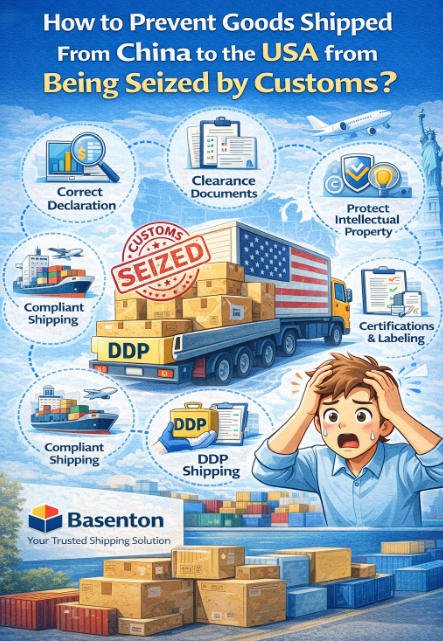
Summary:
For importers shipping goods from China to the United States, “avoiding customs detention” and “ensuring warehouse compliance” are the two most significant challenges in the import process. Completing compliance certifications in advance, organizing documents, accurately classifying goods, and choosing the appropriate transportation mode (DDP, air freight, sea freight, express delivery) are all crucial steps in mitigating risks.
Basenton Logistics has long provided US customers with transportation, customs clearance, tax handling, and warehouse delivery services from China to the United States, including FBA warehousing, DDP services, and compliance planning for high-risk products. For customers lacking import qualifications, customs clearance experience, or those needing replenishment for e-commerce platforms, Basenton can provide support in document review, compliance advice, customs clearance strategies, and logistics execution, improving transportation efficiency and reducing customs risks.
News
Berita Teknologi
Berita Olahraga
Sports news
sports
Motivation
football prediction
technology
Berita Technologi
Berita Terkini
Tempat Wisata
News Flash
Football
Gaming
Game News
Gamers
Jasa Artikel
Jasa Backlink
Agen234
Agen234
Agen234
Resep
Cek Ongkir Cargo
Download Film
