
What does Demurrage Mean – Basenton
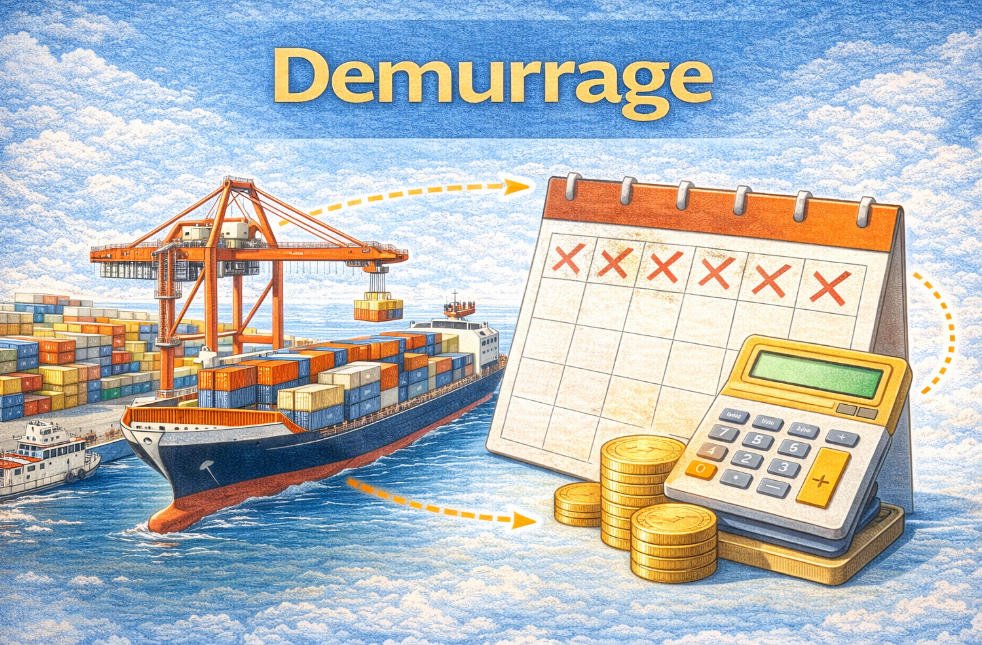
Demurrage refers to the fees payable by the cargo owner, shipper, or consignee for failing to pick up or deliver goods within the “free time” stipulated in the charter party agreement.
“Free time” refers to the free period granted by the port, terminal, or other location for the loading and unloading of empty containers by the vessel, shipper, or their agent, usually ranging from two to seven days. Failure to return the containers within the free time will incur demurrage charges, which can be charged on an hourly or daily basis.
Definition of Demurrage
Demurrage, usually translated as demurrage fee or terminal storage fee, refers to the fee charged by shipping companies or terminals to cargo owners when containers exceed the free storage period (Free Time) at the port or terminal.
Simply put, ports allow containers to be stored at the terminal for a certain number of days free of charge. Once this period is exceeded, regardless of whether customs clearance has been completed or the goods have been picked up, charges will begin to accrue.
In international logistics and sea freight, demurrage is a common fee that often leads to unexpected cost increases for many importers and sellers. Many companies don’t fully consider this cost during the quoting stage, but after the goods arrive at the port, they are often forced to bear high demurrage charges due to delays in customs clearance or cargo collection.
Especially for goods exported from China to overseas ports (such as the US, Europe, and the Middle East), demurrage is almost one of the most common and easily overlooked hidden costs. Understanding the meaning of demurrage, its causes, and how to avoid it is a crucial part of controlling logistics costs.
The essence of demurrage is not a “fine,” but rather a cost for resource utilization. Ports and shipping companies hope to encourage the prompt customs clearance and removal of goods from the terminal through this fee mechanism.
How is demurrage typically charged?
Demurrage charges are set by the shipping company or terminal, and vary significantly depending on the port and shipping route.
General characteristics include:
- Lower fees for the first few days
- The longer the delay, the higher the daily fee
- Fees increase significantly during peak seasons (such as the end of the year)
- Higher demurrage charges are applied to any special cargo, excessive handling, or containers unsuitable for normal storage.
For example, for containers shipped from China to the United States, the common free period is 3–7 days, after which charges may be applied daily, with fees increasing in a tiered manner.
Who is responsible for paying demurrage charges?
Regarding demurrage charges, it is usually stipulated that the party responsible for the goods (e.g., the importer or exporter) bears the cost. However, when demurrage charges actually occur, the transportation contract will clearly specify who is responsible for the costs. All stakeholders must understand and abide by the shipping company’s terms to avoid incurring additional charges.
Typically, demurrage charges are paid by the cargo owner, especially importers or exporters who fail to pick up or deliver the goods within the stipulated time. While customs itself is not responsible for delays caused by delays in processing customs declarations, third parties (such as freight forwarders) may be held liable, especially if they fail to prepare the documents as required.
The Difference Between Demurrage and Detention
In international shipping, demurrage is often confused with detention, but the two are not entirely the same.
Demurrage:
This refers to the charge incurred when a container exceeds the free time allowed at the port or terminal.
Detention:
This refers to the charge incurred when a container is not returned within the allotted time after being picked up from the port and taken to the customer’s warehouse or other external location.
For goods exported from China, if customs clearance is slow at the destination port, demurrage will usually be incurred first; if customs clearance is completed but the container return is delayed, then detention charges will apply.
Common Triggers of Demurrage in Shipping from China
For goods shipped from China, demurrage is often not caused by a single error, but rather by a combination of factors across multiple stages.
Common causes include:
- Incomplete or incorrect customs clearance documents
- Inaccurate HS Code declaration, triggering inspection
- Changes in destination port policies or port congestion
- Buyer failing to arrange trucking or warehousing in advance
- Using non-DDP terms, leading to unclear responsibility boundaries
In major ports such as those in the United States and Europe, demurrage is almost inevitable once the inspection process begins.
Demurrage Risk Varies Depending on the Destination Region from China
China → United States
- High port inspection rate
- Complex customs clearance process
- Higher demurrage risk
China → Europe
- VAT and EORI affect customs clearance speed
- Multiple transshipments increase uncertainty
China → Middle East
- Strict document compliance requirements
- Lack of customs clearance experience easily leads to delays
Therefore, demurrage is not a “random occurrence,” but is highly correlated with the destination country’s policies and operational experience.
How to effectively avoid or reduce demurrage costs?
While demurrage cannot be completely avoided, the risk can be significantly reduced through advance planning.
Practical suggestions include:
- Preparing complete and accurate customs clearance documents in advance
- Confirming the HS Code and declared value before export
- Confirming the free storage period at the destination port with your freight forwarder
- Booking trucking and warehousing services in advance
- Prioritizing DDP or door-to-door solutions for new markets
For companies exporting from China, proactive control is far more important than reactive solutions.
Choosing a Freight Forwarder for Demurrage Control
Many demurrage problems don’t occur at the port, but rather stem from insufficient planning and preparation before shipment.
Chinese freight forwarding companies like Basenton typically assist clients before shipment by:
- Reviewing customs clearance documents and declaration logic
- Reminding clients of free time at the destination port and potential risks
- Coordinating customs clearance, trucking, and warehousing schedules
- Providing DDP or door-to-door solutions to reduce fragmented responsibilities
By unifying the planning of transportation and customs clearance processes, demurrage costs caused by information asymmetry can be effectively reduced.
News
Berita Teknologi
Berita Olahraga
Sports news
sports
Motivation
football prediction
technology
Berita Technologi
Berita Terkini
Tempat Wisata
News Flash
Football
Gaming
Game News
Gamers
Jasa Artikel
Jasa Backlink
Agen234
Agen234
Agen234
Resep
Cek Ongkir Cargo
Download Film
